Reading a hand rank chart without memorising it
Filed under: Card games, Odds and probability — permalink
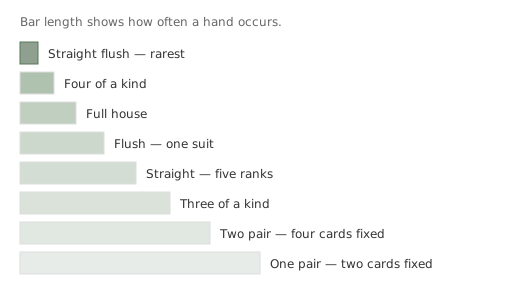
A hand rank chart is really a frequency table read backwards: the rarer the five-card combination, the higher it sits. Once that is clear the order stops being a list to learn and becomes something you can reconstruct at the table from counting alone.
There are 2,598,960 distinct five-card hands drawn from a standard fifty-two card deck. That figure is the denominator behind every line of the chart. Each hand type occupies some share of it, and the ranking is nothing more than those shares sorted from largest to smallest.
Counting from the bottom up
Start with one pair, the most common made hand. Choose the rank that pairs, choose two of its four suits, then choose three further cards of three different remaining ranks with any suits. The count is large because almost nothing constrains the last three cards. Two pair constrains two of them, so it is rarer, so it ranks above.
Three of a kind asks for three suits of a single rank instead of two, which cuts the count again. A straight demands five consecutive ranks, of which there are only ten sequences, though each sequence can be built from any suits. A flush demands one suit across five ranks, of which there are far fewer than the straight sequences allow, which is exactly why the flush sits above the straight rather than below it.
Where the order surprises people
The straight-versus-flush pair is the line most often misremembered, and it is worth working through once rather than trusting a mnemonic. It is also the line that changes when the deck changes: strip cards out of a deck, or add wild cards to it, and the counts move, which can genuinely reorder hands in variants that use non-standard decks.
A full house combines a triple and a pair, so it is constrained on all five cards and sits above both. Four of a kind fixes four cards outright. The straight flush fixes all five in both rank sequence and suit, which is why it tops the chart in a standard deck.
Why reconstructing beats memorising
A memorised list survives only as long as the game matches the one you learned it for. The counting argument transfers. If you can say why two pair outranks one pair, you can also say what happens to that ranking in a game dealt from a forty-card deck, and you will not be surprised when a variant prints an order that looks wrong at first glance.